
Why Your Garage Door Won’t Close in Youngstown, OH — And the One Winter Cause Most Guides Miss
A garage door that won’t close usually has a safety sensor issue, a force-setting problem, or a mechanical obstruction — but in Youngstown, the most overlooked cause is a bottom rubber seal frozen to an icy concrete threshold, which creates enough resistance to trick the opener into reversing. If your door stops about an inch off the ground and reverses every time, that’s your first check before you touch anything else. For same-day Garage Door Repair anywhere in Youngstown, call Premier Garage Door Service Greater Youngstown at (877) 517-2561 — Anthony handles the job himself, and estimates are free.
The Youngstown Winter Problem: When Your Bottom Seal Becomes a Doorstop
Youngstown sits in the Lake Erie snow belt, pulling down 55–65 inches of snow most winters with hard freeze-thaw cycles that punish garage doors harder than almost anywhere else in Ohio. We’ve pulled up to homes in Wick Park, Brier Hill, and the south side after a cold snap to find the same thing: a perfectly functional opener, aligned sensors, and a door that simply won’t seat because the rubber weatherstrip bonded to the slab overnight.
Here’s what happens. Snowmelt runs under the door during the day, refreezes after sundown, and by morning your bottom seal is essentially glued to the concrete. The opener’s force sensor reads that resistance as an obstruction — which is exactly what it’s designed to do — and reverses the door to protect whatever it thinks is underneath. The door isn’t broken. The opener isn’t broken. But the system is doing its job too well.
How to check this in 60 seconds:
- Look at the gap. If the door consistently stops at the same height — usually ½ to 2 inches off the floor — and reverses immediately, suspect the seal before anything else.
- Visually inspect the bottom seal for ice glazing, frost buildup, or visible contact with frozen water on the threshold.
- Don’t force the door down with the opener button — that strains the motor and can strip nylon drive gears, especially on older Craftsman or Chamberlain chain-drive units we see a lot of in Youngstown’s 1920s–1950s housing stock.
- Instead, pull the red emergency release cord (with the door fully closed or supported), then manually lift the door slightly to break the ice bond. Wipe the threshold dry, reconnect the opener, and test.
If the door closes smoothly after breaking the seal, you’ve found your culprit. If it still reverses, move through the diagnostic tree below. And if you’re working with a door in one of those small detached garages common to Youngstown’s steel-era neighborhoods — often 8-foot openings framed in the 1930s — take extra care with that manual lift. Decades of deferred maintenance mean rotted sill plates and corroded hardware aren’t uncommon, and a door that’s heavier than it should be may indicate a spring already near failure.
Reading Your Opener’s Lights: What LiftMaster and Genie Are Trying to Tell You
Most homeowners in Youngstown have never noticed the small LED indicators on their garage door opener’s safety sensors. These lights are diagnostic tools, not decoration — and learning to read them saves you a service call about half the time.
On LiftMaster, Chamberlain, and Craftsman units (all built by the same manufacturer and sharing the same sensor design), each sensor has an indicator light. One side glows amber constantly when powered; the other glows green only when the sensors are aligned and unobstructed. If the green light is off, blinking, or dim, the sensors aren’t “seeing” each other — could be misalignment, could be spiderwebs, could be a leaf blown in during yesterday’s lake-effect gusts.
On Genie systems, the pattern differs slightly: both sensors typically show solid red when aligned, and one or both will blink when the beam is interrupted. Check your specific model — the indicator behavior is printed on a label most people never read.
Quick sensor alignment test: Stand between the sensors and wave your leg through the beam while someone presses the close button. If the door reverses immediately, the sensors are working — they’re just seeing something else they don’t like. If the door continues trying to close, the sensors may be wired incorrectly or one has failed internally.
We’ve found sensors knocked out of alignment by snow shovels, basketballs, and once, in a Crandall Park garage, a determined raccoon. The fix is usually a gentle manual adjustment — but if the mounting brackets are rusted through from decades of salt and moisture exposure, that’s a different repair entirely.
Sensor Problem, Force Problem, or Mechanical Problem? How to Tell the Difference
A door that won’t close behaves differently depending on the root cause. Here’s how we sort them in the field:
| Symptom | Likely Cause | What to Check |
|---|---|---|
| Reverses at bottom, consistent gap | Ice-bonded seal or force limit set too low | Threshold ice, then force adjustment dial |
| Reverses midway or at random height | Track friction, roller binding, or bent track | Visual track inspection, roller condition |
| Won’t move at all, motor hums | Broken spring, cable off drum, or seized opener | Spring gap, cable tension, manual release test |
| Reverses immediately, no travel | Sensor obstruction or misalignment | LED indicators, physical blockage |
| Closes partially, then reopens fully | Travel limit set incorrectly | Limit switch adjustment on opener |
The distinction matters because chasing the wrong symptom wastes time and can create new problems. We’ve seen homeowners crank up the force setting to overcome what they think is “stiffness,” when the real issue was a frayed cable about to snap — turning a $180 cable repair into a dangerous failure. 14 years, one specialty: we know the difference because we’ve seen every variation across eight major brands.
Force settings are not a fix for mechanical problems. The force adjustment on your opener — usually a small dial or screw labeled “force” or “sensitivity” — is calibrated for your door’s normal operating resistance. Raising it to compensate for binding rollers, a dented track, or a deteriorating spring only masks the underlying issue and risks crushing whatever obstacle the safety system was designed to detect. In Youngstown’s older housing stock, where garages have gone 20–40 years without maintenance, that underlying issue is almost always present.
When the Track, Rollers, or Springs Are the Real Culprit
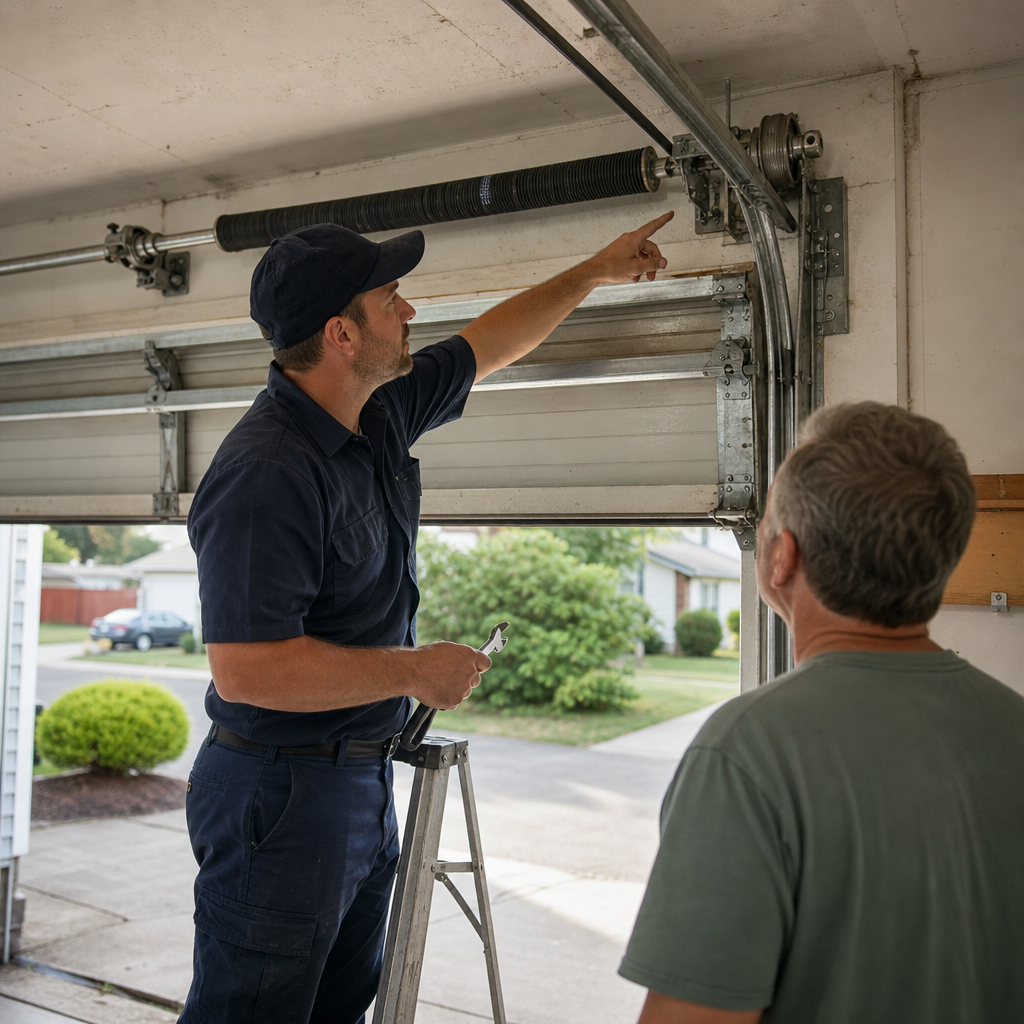
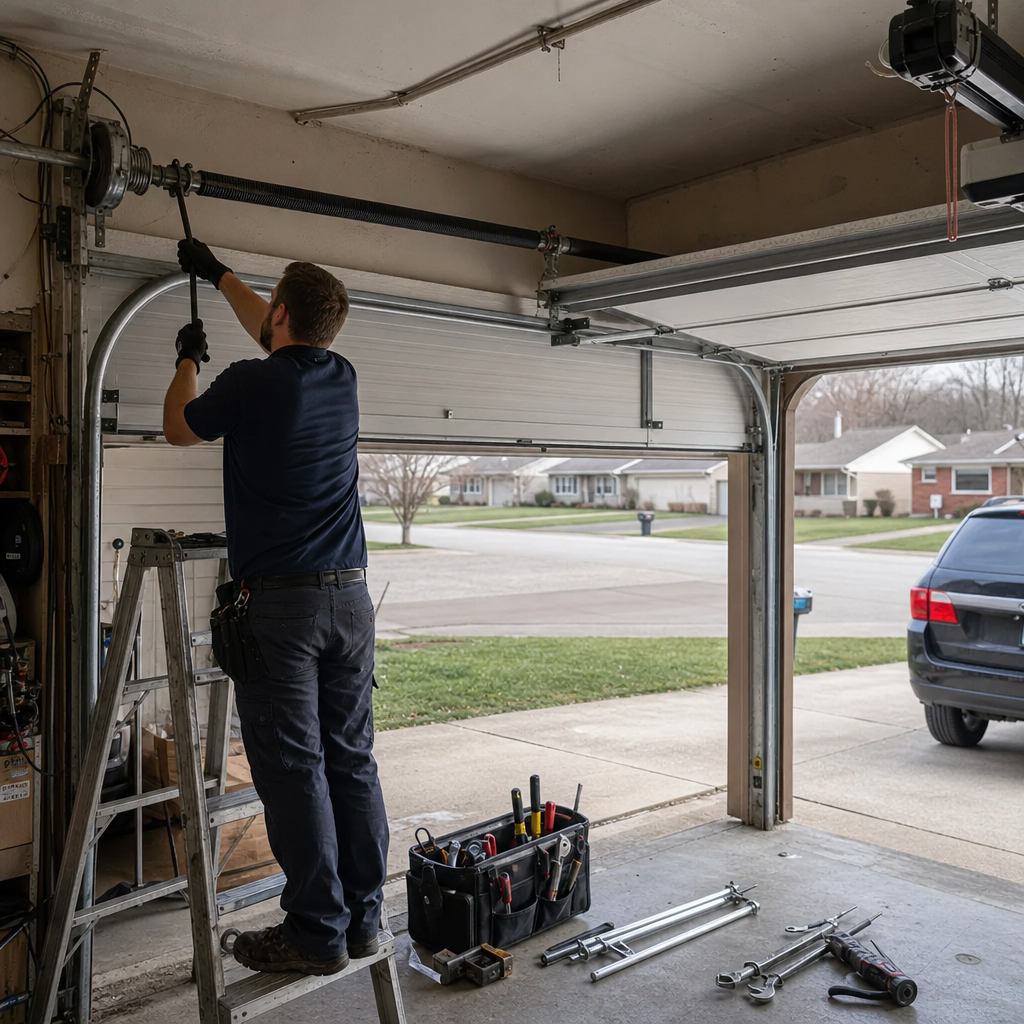
Sometimes a door that “won’t close” is actually a door that can’t close because something mechanical is preventing full travel. We’ve replaced torsion springs that snapped during single-digit nights in January, pulled cables back onto drums after ice buildup threw the door out of balance, and realigned tracks that shifted when freeze-thaw cycles heaved the garage slab out of level — a recurring problem in Youngstown that inland Ohio cities simply don’t see as often.
Warning signs it’s mechanical, not electrical:
- The door travels partway, then stops and reverses — or just stops dead.
- Manual operation (emergency release pulled) feels heavy, uneven, or grinds at certain points.
- You can see a visible gap in the torsion spring above the door, or a cable hanging loose.
- The door closes on one side faster than the other, indicating cable tension imbalance.
Critical safety note: Torsion springs store massive energy and can cause serious injury or death if handled improperly. We’ve seen someone try to “fix” a broken spring with zip ties (don’t do that). If you suspect a spring or cable issue, stop troubleshooting and call a trained professional. Anthony handles the job himself — not a subcontractor learning on your door — and Emergency Garage Door Repair in Youngstown, OH is available when the door won’t wait.
What Garage Door Repair Costs in Youngstown
Most “door won’t close” calls in Youngstown fall into standard repair pricing. Here’s what we typically see:
| Repair Type | Youngstown Price Range |
|---|---|
| Sensor realignment / cleaning | $120–$180 |
| Opener force / limit adjustment | $120–$180 |
| Spring repair | $180–$340 |
| Cable repair | $130–$250 |
| Opener repair | $120–$320 |
| Track realignment | $120–$240 |
| Roller replacement | $110–$220 |
| Bottom seal replacement (if torn from ice removal) | $150–$280 |
The total for most “won’t close” diagnoses runs $150–$600, depending on what we find. We quote upfront before starting work — no padding, no surprises. That’s how we’ve earned 524 verified customer reviews with a 4.7-star rating.
FAQs
Most repairs run between $150 and $600, with simple sensor or force adjustments at the lower end and spring or cable work toward the middle. Call (877) 517-2561 for an exact quote — estimates are free.
You can safely check for ice-bonded seals, clean sensor lenses, and verify LED alignment indicators — but stop if the problem involves springs, cables, or anything requiring tools beyond a stepladder. A door that won’t close is a security vulnerability, and continued DIY attempts can damage the opener or dislodge weakened hardware. If the cause isn’t obvious in five minutes of checking, call for same-day service.
In Youngstown winters, the most common cause is a rubber bottom seal frozen to an icy concrete threshold, creating resistance that triggers the opener’s safety reverse. Check this first before adjusting force settings or realigning sensors — it’s a 60-second test that solves the problem without spending a dollar.
We service all major garage door and opener brands — LiftMaster, Chamberlain, Genie, Clopay, Amarr, Wayne Dalton, Craftsman, and Raynor — so we work on your brand, whatever it is. Anthony’s 14 years of focused experience means he’s seen your specific model before and knows its common failure modes.
When to Stop Troubleshooting and Call
There’s a point where checking becomes guessing — and guessing with a 150-pound door under spring tension isn’t a game worth playing. If you’ve cleared ice from the threshold, verified sensor alignment, and the door still reverses or won’t move, the cause is likely mechanical and potentially dangerous. For the Best Garage Door Repair in Youngstown, OH, call Anthony directly. A door that won’t close leaves your home exposed, and in Youngstown’s older neighborhoods where detached garages often store tools, bikes, or vehicles, that’s not a situation to leave overnight.
We’re not going to tell you every problem is an emergency. But we will tell you when it is one — and when it isn’t. That’s the difference between a technician who shows up to fix what’s actually wrong and one who sells you parts you don’t need. If it rolls up and closes tight, we did our job.
If you’d rather have it looked at, Premier Garage Door Service Greater Youngstown offers a no-pressure assessment anywhere in Youngstown — call (877) 517-2561 or visit our home page to schedule. Anthony handles the job himself, and we’ll get your door closing properly before the next freeze.
Written by Anthony Perez, Owner & Lead Technician at Premier Garage Door Service Greater Youngstown, serving Youngstown, OH.