
Last updated July 10, 2026
Garage Door Repair Maintenance Checklist for Youngstown Homeowners
Here’s something that surprises most Youngstown homeowners: the number-one call we get after a harsh winter isn’t a broken spring — it’s a door that worked fine in October and won’t move in February because nobody caught the early warning signs the previous fall. After 14 years of servicing garage doors across Youngstown, from Boardman to Canfield to the north side, we’ve learned that most expensive repairs are preventable with a disciplined seasonal checklist. This guide gives you the exact inspection points, tests, and maintenance tasks we perform ourselves — organized by season, with clear boundaries between safe DIY work and jobs that require a trained technician.
Quick Answer
A complete garage door maintenance checklist for Youngstown homeowners includes four seasonal inspections: pre-winter weatherproofing in October, post-thaw assessment in April, mid-summer heat checks in July, and year-round monthly safety tests. Critical tasks include testing auto-reverse function, inspecting torsion springs for gap expansion, lubricating rollers and hinges with silicone-based grease rated for Ohio’s temperature swings, and clearing track debris before it causes opener strain. Torsion spring work, cable replacement, and tension adjustments should never be attempted without professional training.
Table of Contents
- Seasonal Timing: When to Do What in Youngstown
- Visual Inspection: Reading the Early Warning Signs
- The Lubrication Guide: What, Where, and What Never to Use
- Monthly Safety Tests Every Homeowner Should Perform
- Weatherproofing for Northeast Ohio Winters
- Opener Maintenance: Motors, Sensors, and Smart Systems
- Common Mistakes to Avoid
- When to Call a Professional
- Frequently Asked Questions
- The Bottom Line
Seasonal Timing: When to Do What in Youngstown
Youngstown’s freeze-thaw cycle is brutal on garage doors. Temperatures swing from single digits to 60°F within weeks, and that expansion-contraction pattern creates specific failure windows. We’ve structured this checklist around the actual rhythm of service calls we see across the Mahoning Valley.
October: Pre-Freeze Preparation (Critical Window)
This is the most important maintenance period of the year. In our experience, roughly 40% of winter emergency calls in Youngstown trace back to issues that were visible in October but ignored.
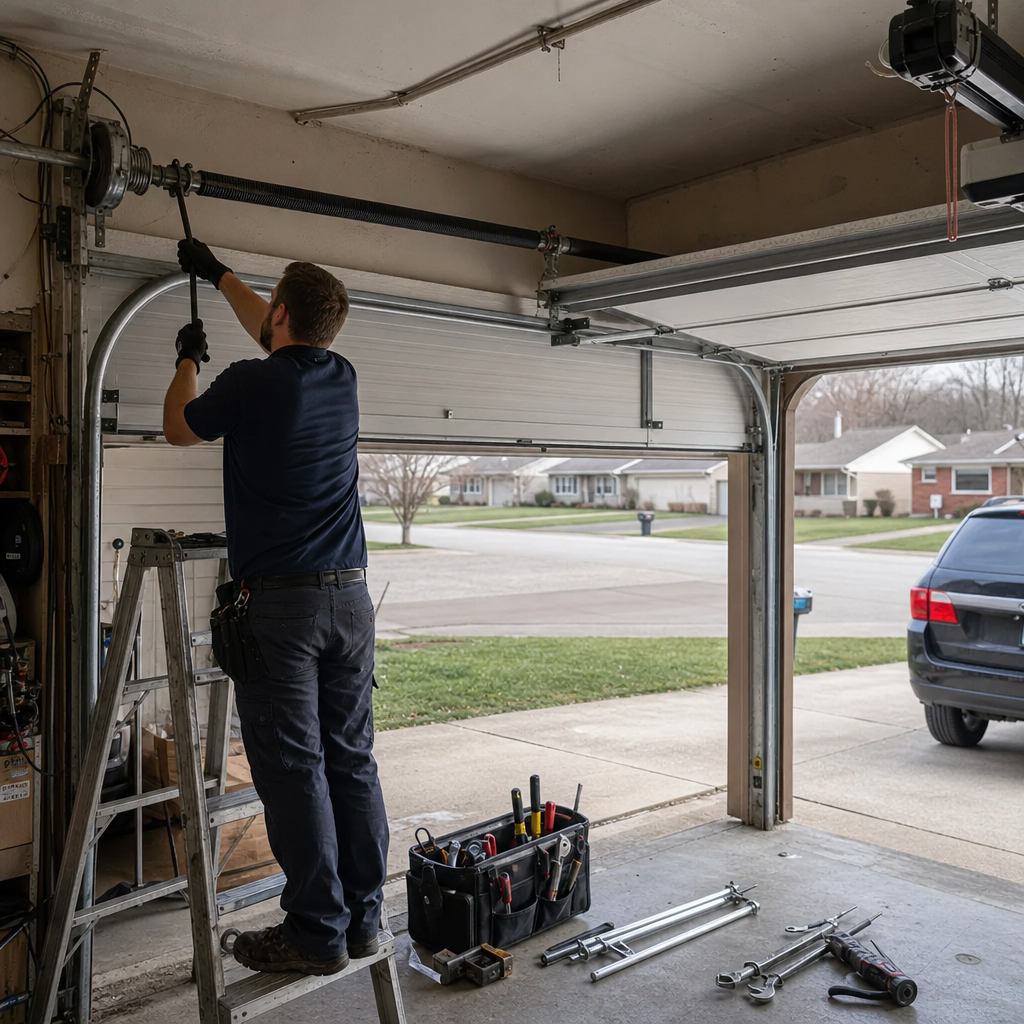
- Inspect torsion springs for coil gaps. Look at the spring mounted above your door. Healthy coils sit tight together. If you see daylight between coils — even a thin line — that spring has lost tension and is working overtime. In Youngstown’s cold, a weakened spring often fails completely on the first hard freeze morning when the metal contracts further.
- Test door balance. Disconnect the opener (pull the red release cord) and lift the door manually to waist height. It should stay put. If it crashes down or rises on its own, the spring tension is off — and your opener is absorbing that strain every cycle.
- Lubricate before the cold sets in. Silicone-based lubricant stays workable below 0°F; standard garage sprays gum up. Apply to rollers, hinges, and bearing plates — never to the track itself (more on this below).
- Check weatherstripping on the bottom seal. If it’s cracked or pulling away, meltwater will seep in, freeze at the threshold, and glue your door shut by January.
April: Post-Thaw Assessment
After the snow melts, we see a second wave of calls — usually from moisture damage or from homeowners who forced a frozen door and misaligned the track.
- Inspect for rust bloom on springs and cables. Road salt and garage moisture accelerate corrosion. Surface rust is cosmetic; flaky, pitted rust weakens the metal.
- Check track alignment. Look for gaps between the rollers and track, or bends in the vertical sections. A door that “sticks” at one point in its travel usually has a track issue, not an opener problem.
- Re-test auto-reverse. Salt buildup on the floor can interfere with infrared safety sensors. Clean the lenses and verify the door reverses on contact with a 2×4 laid flat.
July: Heat and Humidity Checks
Summer in Youngstown brings high humidity that swells wooden doors and stresses opener electronics in uninsulated garages.
- Inspect wooden door panels for warping or delamination. Even steel doors with wood-grain overlay can trap moisture at seams.
- Check opener motor housing temperature after a full open-close cycle. If it’s too hot to touch comfortably, the motor is working harder than designed — often because of door balance issues or worn rollers creating drag.
- Verify photo-eye alignment. Direct summer sun can blind sensors temporarily; make sure they’re angled slightly downward and shielded from glare.
Visual Inspection: Reading the Early Warning Signs
After 14 years in the trade, Anthony can often diagnose a door from across the driveway. Here’s what we’re looking for — and what you can train yourself to see.
Torsion Springs: The 2-Week Warning
A failing torsion spring doesn’t snap without notice. The visual cue most homeowners miss is coil separation. A healthy spring has coils that touch or nearly touch along its entire length. When a spring nears failure, you’ll see:
- A gap of ⅛ inch or more between adjacent coils — this means the spring has stretched and lost its calibrated torque
- Rust streaks radiating from the center mount — indicates the spring is flexing unevenly and wearing the stationary cone
- A slight tilt to the spring tube — one spring in a dual-spring system is carrying more load as the other weakens
We’ve replaced springs in Youngstown homes where the homeowner noticed the gap in October, meant to call, and woke up to a trapped car in February. The gap doesn’t close — it expands until failure.
Cables: Fraying Before Breaking
Lift cables run vertically alongside the door. Look for:
- Individual wire strands protruding from the cable braid (bird-caging)
- Flattened or kinked sections, usually where the cable wraps around the bottom bracket
- Black grease streaks on the door panels — indicates the cable is rubbing against the track edge
Safety note: Garage door cables are under extreme tension from the torsion spring system. A frayed cable can snap without warning, and the recoil can cause serious injury. Visual inspection is appropriate for homeowners; cable replacement is not.
Rollers and Hinges: The Wear Pattern
Nylon rollers should roll smoothly; steel rollers will show a polished wear track. Replace rollers when:
- Nylon rollers have flat spots or cracks — they’ll start “skidding” instead of rolling, creating track wear
- Steel rollers grind or squeal despite lubrication — the bearing is shot
- Any roller wobbles in the track — the stem is bent or the track is spreading
Hinge pins should be tight in their barrels. A hinge that shifts side-to-side will eventually wallow out the door panel mounting holes, and that’s a panel replacement, not a hinge fix.
The Lubrication Guide: What, Where, and What Never to Use
This is where most DIY maintenance goes wrong. The wrong lubricant in the wrong place attracts grit, gums up in cold, or creates a slip hazard on the track.
What to Use in Youngstown’s Climate
Ohio’s temperature range demands a lubricant that stays fluid at -10°F and doesn’t thin out at 90°F. We use and recommend:
- Silicone-based spray lubricant (white lithium grease in aerosol form) for hinges, rollers, and bearing plates
- Garage door-specific synthetic grease for torsion spring coils — it clings without dripping onto the door or floor
WD-40 is not a lubricant for this application — it’s a solvent and light penetrant that evaporates, leaving metal bare. We’ve seen homeowners spray it on rollers in October; by February, they’re calling us for a full roller replacement.
Where to Apply — and Where to Avoid
| Component | Lubricate? | What to Use |
|---|---|---|
| Rollers (bearings and stem) | Yes — light coat | Silicone spray |
| Hinges (pivot points) | Yes — light coat | Silicone spray or white lithium |
| Torsion spring coils | Yes — moderate coat | Garage door synthetic grease |
| Bearing plates (end of spring tube) | Yes — light coat | Silicone spray |
| Track interior surface | No | N/A — attracts grit, reduces friction control |
| Chain or screw drive | Yes — if manufacturer specifies | Opener-specific grease (check manual) |
| Belt drive | No | N/A — silicone degrades rubber compounds |
The track is the most common misapplication. Rollers are designed to roll, not slide. Lubricating the track makes rollers slide, which wears them flat and creates a safety issue if the door needs to be operated manually during a power outage.
Monthly Safety Tests Every Homeowner Should Perform
These three tests take under five minutes and can prevent injury or property damage. We demonstrate them for every customer after a garage door repair in Youngstown — they’re that important.
Test 1: Auto-Reverse (Mechanical)
- With the door fully open, place a 2×4 board flat on the floor in the center of the door path.
- Close the door using the wall button (not the remote).
- The door should reverse within 2 seconds of contacting the board.
If the door stops but doesn’t reverse, or if it crushes the board, the down-force limit needs adjustment. This is opener-specific — a LiftMaster adjustment differs from a Genie or Craftsman procedure. Consult your manual or call for service.
Test 2: Auto-Reverse (Photoelectric)
- Start the door closing with the wall button or remote.
- Wave a broomstick through the beam between the two sensor units (mounted 4-6 inches above the floor on each side of the track).
- The door should reverse immediately.
Dirty or misaligned sensors cause more “my door won’t close” calls in Youngstown than actual opener failures. Clean the lenses monthly with a dry cloth — moisture residue from garage floors fogs them up.
Test 3: Door Balance
- Close the door and pull the red emergency release cord to disconnect the opener trolley.
- Lift the door manually to about waist height (3-4 feet).
- Release it smoothly.
A balanced door stays at that height. A door that falls indicates weak or broken springs; a door that rises indicates excessive spring tension. Both conditions damage your opener over time — the motor is designed to move a balanced door, not to compensate for spring problems.
Critical safety note: If you discover a balance problem, do not attempt to adjust spring tension yourself. Torsion springs store enough energy to cause severe injury or death. This is the single most dangerous maintenance item on any residential garage door.
Weatherproofing for Northeast Ohio Winters
Youngstown’s position in the snow belt means garage doors face conditions that southern Ohio homeowners don’t. We’ve pulled doors frozen to their thresholds in Austintown and replaced bottom seals shredded by ice buildup in Poland.
The Bottom Seal: Your First Defense
The rubber or vinyl strip along the bottom of your door compresses against the concrete threshold. When it’s intact, it blocks wind, water, and rodents. When it fails:
- Meltwater seeps in and re-freezes, creating an ice dam that prevents opening
- Cold air infiltration raises heating bills for attached garages
- Gap allows mice and chipmunks access — a real problem in Youngstown’s older neighborhoods with mature tree cover
Inspect the seal by closing the door on a bright day and looking for light leaks from inside. Replace when you see cracks, permanent compression flats, or sections that don’t contact the floor evenly.
Panel Seals and Perimeter Weatherstripping
Between-section seals on multi-panel doors harden and shrink over 5-7 years. You can test them by running a lit incense stick along the closed door edges on a windy day — smoke disturbance indicates air leaks. Wayne Dalton and Amarr doors use proprietary seal profiles; generic replacements rarely fit correctly. We stock common profiles for garage door installation in Youngstown jobs and can match yours.
Threshold Drainage
This is the Youngstown-specific tip most guides miss: your garage floor should slope slightly toward the door, with the threshold slightly lower than the interior slab. If water pools inside when snow melts, the slope is reversed or the drain is blocked. Chronic moisture rusts bottom fixtures and delaminates wood-composite doors from the bottom up.
Opener Maintenance: Motors, Sensors, and Smart Systems
Modern openers are more reliable than the chain-drive monsters of 20 years ago, but they’re not maintenance-free. Anthony services LiftMaster, Chamberlain, Genie, Clopay, Amarr, Wayne Dalton, Craftsman, and Raynor systems — the maintenance points are similar across brands, with specific exceptions noted.
Chain and Belt Drives
Chain drives need tension adjustment every 2-3 years as the chain stretches. Too loose, and it skips on the sprocket; too tight, and it overloads the motor bearings. Belt drives (LiftMaster’s belt systems, for example) don’t stretch significantly but the belt should be inspected for fraying at the cog engagement points.
Screw Drives
Genie screw-drive openers require specific lubricant on the threaded steel rod — not standard garage spray. The wrong lubricant attracts dust that abrades the carriage nut, causing the characteristic “grinding” failure we see in 8-10 year old Genie units around Boardman.
Force and Limit Settings
After any spring replacement or door hardware repair, the opener’s force limits should be recalibrated. A door that previously needed 15 lbs of opener force to overcome weak springs will slam dangerously hard if those limits aren’t reduced after spring replacement. We verify these settings on every garage door opener in Youngstown service call.
Smart Features and Battery Backup
LiftMaster and Chamberlain’s MyQ systems, and Genie’s Aladdin Connect, add convenience but introduce new failure modes: WiFi connectivity drops, app authentication expires, and battery backup systems (now required by Ohio building code for new installations) need annual testing. Press the test button on the battery unit — if it doesn’t power the opener through one full cycle, replacement is due.
Common Mistakes to Avoid
- Using WD-40 as a lubricant. It cleans, penetrates, and evaporates — leaving metal unprotected. In Youngstown winters, that means frozen rollers and seized hinges by February. Use products labeled specifically for garage door application.
- Ignoring a single loud pop from the garage. That sound is almost always a torsion spring breaking. Continuing to operate the door with one broken spring in a dual-spring system overloads the remaining spring and bends the top section. Stop using the door immediately.
- Adjusting track alignment with the door connected to the opener. The opener holds tension on the door; loosening track bolts with that tension applied can spring the track outward with significant force. Disconnect the opener first.
- Pressure-washing the door and components. We’ve seen homeowners blast road salt off their door in March — and force water into roller bearings, hinge barrels, and the opener housing. Wipe down with a damp cloth; use low-pressure rinse only for the door exterior, keeping the spray away from mechanical components.
- Skipping the monthly safety tests because “it’s been fine.” The 524 customers who’ve reviewed our service include several who wish they’d tested their auto-reverse before a grandchild visited. It takes two minutes.
- Attempting spring or cable work after watching a YouTube video. The tools and techniques shown are often incorrect for your specific door system, and the energy stored in a torsion spring doesn’t forgive mistakes. We’ve been called to injuries that happened on “simple” DIY attempts.
- Waiting until the door fails completely to call. A door that groans, shudders, or reverses intermittently is telling you something. Addressing it early typically costs 60-70% less than the emergency repair after total failure.
When to Call a Professional
Some maintenance is genuinely safe for homeowners; some requires training, specialized tools, and an understanding of stored energy that comes from years of hands-on work. Anthony handles the job himself on every call — you’re not getting a trainee with a checklist.
Call Premier Garage Door Service Greater Youngstown at (877) 517-2561 when:
- You see coil gaps, rust streaks, or any damage to torsion springs
- Cables show fraying, kinking, or grease streaks from rubbing
- The door fails the balance test (falls or rises when released at waist height)
- Auto-reverse tests fail after sensor cleaning and alignment checks
- The opener motor overheats, grinds, or operates inconsistently
- You’re unsure whether a noise or movement is normal — we’d rather answer questions than repair preventable damage
We offer free estimates in Youngstown and surrounding communities. When the door won’t wait, emergency garage door service is part of our core offering — not an after-hours upsell.
Frequently Asked Questions
Professional annual maintenance typically runs $120–$180 for a standard residential door, including full inspection, lubrication, safety tests, and minor adjustments. Repairs identified during maintenance — worn rollers, failing springs, cable replacement — are quoted separately before any work begins. Call (877) 517-2561 for an exact quote; estimates are free.
Basic lubrication is safe DIY work if you use the correct products and avoid the track surface. Apply silicone spray to roller bearings, hinge pivot points, and bearing plates; synthetic garage door grease to torsion spring coils. Never lubricate the track interior or belt drives. If you’re uncertain about any component, schedule a maintenance visit and we’ll show you the proper technique for your specific door.
Test both mechanical (2×4) and photoelectric (sensor beam) auto-reverse monthly. In Youngstown, test more frequently during winter when road salt and moisture can foul sensors, and during summer when direct sunlight can temporarily blind the photo-eye. A door that fails either test should not be used until repaired — it’s a safety and liability issue.
Torsion spring failure after visible warning signs were ignored. In our 14 years of service across Youngstown, the pattern is consistent: homeowners notice a gap between spring coils in fall, the door feels heavier, or the opener strains — then the spring breaks in January or February when cold contraction adds stress to already-weakened metal. October inspection prevents February emergency calls.
Repair is more economical when the door structure is sound and the failure is isolated to springs, cables, rollers, or opener components. Replacement makes sense when panels are dented or delaminated, the door is pre-1993 (lacking modern safety features), or repair costs exceed 50% of a new door installed. We assess both options honestly — our Premier Garage Door Service Greater Youngstown home page shows examples of both repair and installation outcomes from real jobs.
We work on your brand — Anthony is certified fluent across eight major manufacturers: LiftMaster, Chamberlain, Genie, Clopay, Amarr, Wayne Dalton, Craftsman, and Raynor. That covers the vast majority of residential systems installed in Youngstown over the past 30 years. We carry common parts for same-day repair on most brands and can source specialty components within 24–48 hours when needed.
The Bottom Line
A garage door maintenance checklist only protects your home if you actually use it — and know what you’re looking for. The seasonal structure we’ve outlined reflects real failure patterns across 14 years of Youngstown service calls: October preparation prevents winter emergencies, April assessment catches thaw damage, July heat checks protect electronics, and monthly safety tests protect people. Know the difference between safe DIY tasks (lubrication, visual inspection, safety testing) and work that demands professional training (anything involving torsion springs or cable tension). Catching problems early doesn’t just save money — it prevents the 6 AM discovery that your car is trapped behind a failed door on the morning you need it most.
Questions about your specific door? Call (877) 517-2561 for a free estimate. Anthony handles the job himself, and 524 customers have weighed in with their experience.
Written by Anthony Perez, Owner & Lead Technician at Premier Garage Door Service Greater Youngstown, serving Youngstown since 2012.