
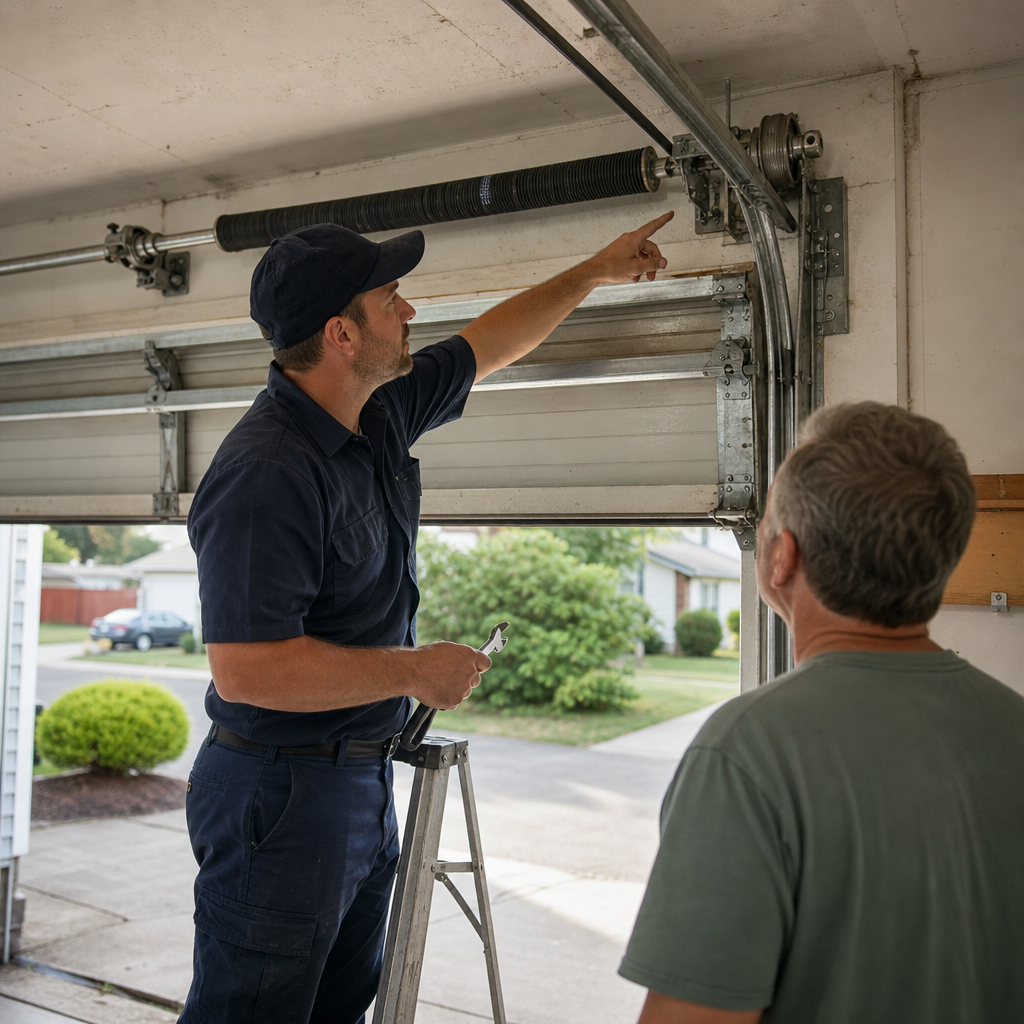
Why Does My Garage Door Reverse in Youngstown, OH?
Your garage door reverses because something is telling the opener there’s an obstruction or too much resistance. In 9 out of 10 calls we get in Youngstown, it’s one of four things: misaligned photo-eyes, dirty or frosted sensor lenses, a close-force setting that’s too sensitive, or a travel limit programmed wrong. The good news? You can diagnose which one in about 90 seconds with no tools, working from cheapest fix to most involved. If you’d rather skip the troubleshooting and get it fixed today, call us at (877) 517-2561 — Anthony handles the job himself, and we’ll walk you through what’s actually wrong before you spend a dollar.
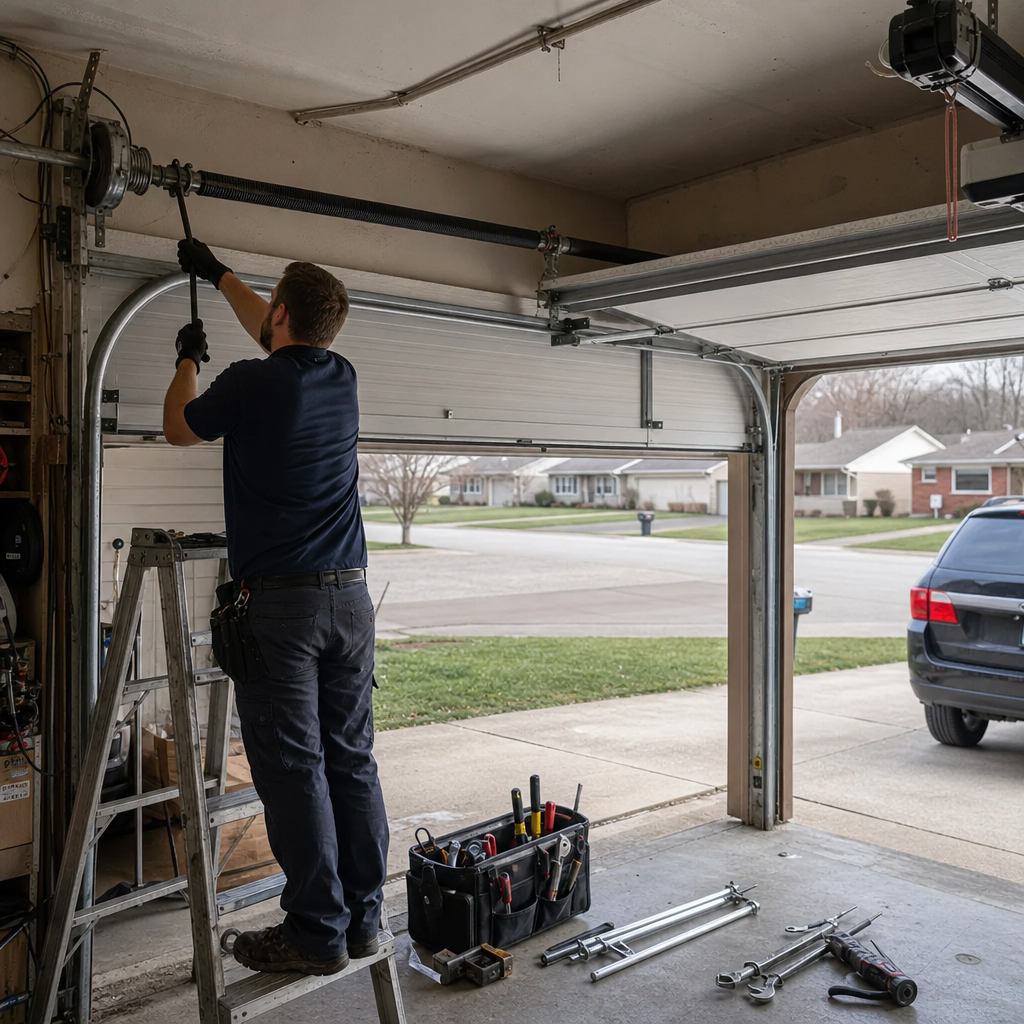
Youngstown’s Freeze-Thaw Reality: Why This Problem Hits Harder Here
Youngstown sits in the Lake Erie snow belt, and that geography turns a simple sensor glitch into a seasonal epidemic. We’re talking 55–65 inches of lake-effect snow most winters, with hard freezes that come in waves. Here’s what that means for your garage door: photo-eye sensors sit 4–6 inches off the floor, right where cold concrete meets even colder air. In an unheated detached garage — and Youngstown’s housing stock is full of them, especially in neighborhoods like Wick Park and Brier Hill where those 1920s–1950s worker cottages have small garages that haven’t seen maintenance in decades — that sensor lens fogs or frosts overnight. The opener reads that condensation as an obstruction. Door reverses. Homeowner stares at it, baffled.
Anthony sees this pattern every January. It’s a 30-second fix — wipe the lens with a dry cloth — but opener manuals bury the diagnostic steps on page 34 of a PDF nobody downloads. So homeowners call us thinking they need a garage door repair in Youngstown, when sometimes they just need to know where to look.
The other local factor: freeze-thaw cycles heave garage slabs and shift door frames out of plumb. A door that tracked fine in October starts binding by February. The opener’s force sensor interprets that friction as an obstruction, and the door reverses partway down — a different symptom than the bottom-of-travel reversal, and one that points to mechanical wear, not sensor failure.
The 90-Second Diagnostic: Four Causes, Tested in Order
We’re going to run these checks from cheapest to most involved. Don’t skip ahead — the first two fixes are free and take under a minute.
Cause 1: Photo-Eye Misalignment or Physical Obstruction
Look at the two small boxes facing each other across your door track, about 4–6 inches off the floor. Most are LiftMaster, Chamberlain, or Craftsman units around here — same underlying logic platform, same troubleshooting rules. One should show a steady small light (usually amber or green). The other should show the same. If either light is out, blinking, or dim, they’re not “seeing” each other.
Quick test: Close the door with the wall button held down continuously. If it closes fully while you’re holding the button, the photo-eyes are the culprit — holding the button overrides the safety system.
What to check: Did a snow shovel, leaf pile, or the recycling bin shift into the beam path? Is one sensor knocked askew from a basketball or a bumped bumper? Tighten the wing nut and pivot it until both lights steady up. In Youngstown’s older garages with rotted sill plates and settled foundations, the whole bracket may have shifted with the frame — we’ve seen sensors pointing at the ceiling because the jamb twisted over 40 years of freeze-thaw.
Cause 2: Dirty or Frosted Lens — The Youngstown Winter Special
This is the one Anthony catches constantly in January and February. Road salt mist, garage humidity from melting snow off your car, and plain old condensation coat the lens. To the infrared eye, that frost reads the same as a solid object.
Quick test: Wipe both lenses with a dry microfiber or paper towel. Don’t use Windex yet — ammonia can leave a film that scatters the beam. Dry is usually enough. If the door closes normally after, you found it.
Prevention: In unheated garages, some homeowners rig a small cardboard shield above the sensor to block dripping condensation. It works, but don’t block the beam path itself — that’s a safety violation and it’ll just reverse again.
Cause 3: Close-Force Limit Set Too Low
Every opener has a force setting that determines how hard the motor pushes before deciding something’s wrong and reversing. Factory settings assume a smoothly rolling door in moderate temperatures. Your door probably isn’t either of those things.
Quick test: Disconnect the opener (pull the red release cord) and lift the door manually. It should move smoothly, stay on track, and hold halfway open without drifting. If it binds, grinds, or feels heavy, the door itself needs attention — adjusting force to compensate just masks a mechanical problem and risks damaging the opener or worse, closing on something it shouldn’t.
If the door moves fine manually, the force setting may have drifted. On LiftMaster/Chamberlain/Craftsman units, this is the blue or grey adjustment screw on the side of the motor housing — but here’s where we stop with DIY guidance. Force settings interact with the safety reverse system, and setting them wrong can create a crushing hazard. We’ll check this in person and set it precisely with a scale test.
Cause 4: Close-Travel Limit Programmed Incorrectly
The opener thinks the floor is 6 inches higher than it actually is. It hits what it believes is the bottom, senses unexpected resistance, and reverses — or it tries to drive the door into the concrete, triggers force overload, and backs up.
Quick test: Watch where the door stops. If it reverses with 3–12 inches still showing, or if the motor keeps running for a second after the door touches down, the travel limit is off. This happens after DIY opener installs, after power outages that scramble memory, or when someone else’s “fix” involved random button-pressing.
Reprogramming limits varies by model year — newer MyQ-enabled LiftMasters use electronic limits set through buttons, older units have physical screws. The manual (that PDF on page 34) has the sequence, or we can dial it in precisely on a service call.
What the Blink Codes Actually Mean (LiftMaster, Chamberlain, Craftsman)
Here’s something the manuals don’t surface clearly: when these openers reverse unexpectedly, the main light or a small diagnostic LED blinks a specific number of times. That count tells you exactly which subsystem triggered the reversal.
- 1 blink: Safety sensor wire is disconnected or shorted — check the low-voltage wiring running between sensors and back to the motor head. In Youngstown’s older garages, rodents sometimes chew these wires, or corrosion gets into splices.
- 2 blinks: Sensor beam is blocked or misaligned — back to Cause 1 above.
- 3 blinks: Door control or wire issue — less common, usually after DIY wiring work.
- 4 blinks: Sensor eyes are slightly misaligned or lenses are dirty — the beam is intermittent, not fully broken. Classic frost/condensation symptom in our climate.
- 5 blinks: Motor overheated or RPM sensor failure — the door is working too hard, usually mechanical resistance (Cause 5 below, not in our main four).
Count the blinks before you call. It saves us both time, and Anthony will confirm what it means for your specific model year.
When Reversing Means Mechanical Trouble, Not Sensor Trouble
This distinction matters for your wallet and your safety. The four causes above — sensors, force, travel limits — are opener-side issues. But a door that reverses partway through the close cycle, not at the bottom, is telling a different story. The opener is correctly sensing real resistance.
Mechanical culprits we see in Youngstown:
- Corroded rollers: Steel rollers in 40-year-old tracks, never lubricated, seize up and drag. The opener reads that drag as an obstruction.
- Track out of plumb: That freeze-thaw slab heave we mentioned shifts the whole door frame. The door binds in the track mid-travel.
- Bottom seal frozen to concrete: After a wet snowfall and hard freeze, the rubber seal bonds to the floor. The opener tries to pull it free, hits resistance, reverses. Don’t force it — you’ll tear the seal or damage the bottom fixture.
- Broken or weak spring: The door is suddenly heavier than the opener was sized for. It starts down fine, then the motor strains, force limit trips, reversal.
Safety note: If you suspect a spring or cable issue — the door feels heavy manually, you see a gap in the torsion spring above the door, or cables are loose — do not attempt repair yourself. Garage door springs carry lethal tension. We’ve seen what happens when someone tries a “quick fix” with zip ties or C-clamps. It doesn’t end well. Call us at (877) 517-2561 — Anthony handles the job himself, and we’ll get it sorted safely.
What You Can Fix vs. What Needs a Technician
We’re straightforward about this. Some of our competitors route every symptom to a service visit. We don’t.
| Problem | Homeowner Fix? | Typical Cost if We Handle It |
|---|---|---|
| Photo-eye misalignment | Yes — tighten wing nut, align until lights steady | Service call minimum if you prefer ($150–$600 range) |
| Frosted/dirty lens | Yes — dry wipe, check after | Usually no charge if that’s all it is on a scheduled visit |
| Close-force adjustment | No — safety-critical, needs scale testing | $120–$320 (opener repair range) |
| Travel limit reprogram | Possible if you have the manual; we can walk through by phone | $120–$320 |
| Corroded rollers | No — requires door in down position, proper tools | $110–$220 (roller replacement) |
| Track realignment | No — precision work, safety risk if wrong | $120–$240 |
| Spring or cable failure | Absolutely not — high-tension hazard | $180–$340 (spring); $130–$250 (cable) |
When you call (877) 517-2561, we’ll ask about the symptoms — blinks, where it reverses, weather conditions, recent changes. Anthony will tell you honestly whether you’re in DIY territory or need a truck roll. Garage door repair is what we do, but we’re not in the business of charging for a wiped lens.
When the Door Won’t Wait: Emergency Service
A reversing door isn’t always an emergency — until it won’t close at all, and it’s 10 p.m., and your car’s stuck outside in a Youngstown January. Or it’s stuck open, and you’re leaving for work. We get it. Emergency garage door service is part of our core offering, not an upsell. Anthony’s the one who answers after hours, and he’s the one who shows up. Home security doesn’t pause for business hours.
FAQs
Most reversing issues we fix in Youngstown fall between $120 and $320, depending on whether it’s a sensor adjustment, force calibration, or Garage Door Off Track Repair in Youngstown, OH and other track work. If the problem is simply misaligned or dirty photo-eyes, we’ll often realign them as part of a standard service call. Call (877) 517-2561 for an exact quote — estimates are free, and we’ll tell you before we head out if it sounds like something you can handle yourself.
You can fix the two most common causes yourself in under two minutes: check for physical obstructions blocking the photo-eye beam, and wipe both sensor lenses clean of frost, condensation, or road salt film. If those don’t solve it, or if the door reverses mid-travel (indicating mechanical resistance), call us for Emergency Garage Door Repair in Youngstown, OH — force settings, spring issues, and track alignment require professional tools and safety protocols. We’re happy to walk you through the quick checks by phone first.
Condensation or frost on the photo-eye lenses is the culprit in nearly every cold-weather reversal call we get in Youngstown. Unheated detached garages — common in the city’s older neighborhoods — let humidity from melting snow freeze onto the infrared sensor overnight. The opener reads that frost as a solid obstruction. Wipe the lenses dry; if the problem persists, the sensors may be misaligned from slab heave or frame shift, which we see constantly after freeze-thaw cycles.
Repair is almost always cheaper. Sensor realignment, force adjustment, or travel limit programming runs $120–$320, while a new opener installation starts at $250–$550 plus labor. We only recommend replacement if your opener is 15+ years old, lacks modern safety features, or has failed multiple components. Anthony will assess honestly — 14 years in this trade means we’ve seen openers that just need a tweak and others that are money pits. We’ll tell you which yours is.
Key Takeaways
- Start with the 90-second diagnostic: obstruction, dirty lens, force setting, travel limit — in that order.
- Youngstown’s lake-effect winters make frosted photo-eye lenses a seasonal pattern; try the dry wipe first.
- Count the diagnostic blinks on LiftMaster, Chamberlain, or Craftsman units — they tell you exactly what’s wrong.
- Door reversing mid-travel means mechanical resistance, not sensor failure — don’t mask it with force adjustments.
- Never attempt spring, cable, or high-tension repairs yourself.
If you’d rather have it looked at, Premier Garage Door Service Greater Youngstown offers Best Garage Door Repair in Youngstown, OH with a no-pressure assessment — call (877) 517-2561. Anthony handles the job himself, works on your brand, and 524 customers have weighed in on the results. If it rolls up and closes tight, we did our job.
Written by Anthony Perez, Owner & Lead Technician at Premier Garage Door Service Greater Youngstown, serving Youngstown, OH.